Best Beginner Sewing Projects: What to Look For Before You Buy
“Best” means easiest to finish, not nicest on the envelope
The best beginner sewing projects are the ones you will complete, press, and use. That is a colder test than “cute,” and it is a better one. Good sewing projects for beginners have few pieces, mostly straight seams, instructions written in full sentences, and a fabric suggestion you can actually sew with on a basic machine. Cool sewing projects for beginners that also involve invisible zips, eyelashes of eased sleeves, and a cloth that moves like water are, in practice, intermediate projects in a hopeful wrapper.
This is a buying filter, not a ranked product test, and not a promise that any named pattern company will always be kind. Look at the skills, the piece count, and the cloth, then spend. Simple sewing projects for beginners, and free sewing projects for beginners when they are legitimately free, still have to pass the same filter. Free is not the same as easy, and it is not the same as clearly written.
If you want clothes eventually, start with a non-fitted object, then a loose garment. If you only want useful household things, you may never need a bodice. Either path is reasonable. Buying six beginner-friendly kits at once is not.
A table of things to look for before you pay
| Feature | A good sign in a beginner project | A warning sign | Why it matters when you are new |
|---|---|---|---|
| Number of pattern pieces | A handful, with names you can follow | A sheet crowded with tiny facings, linings, and “optional” extras that are not really optional for the look | Each piece is a chance to cut two by mistake, or none |
| Seams | Mostly straight, or gentle curves, with a steady seam allowance | Many short, tight curves, or construction that depends on a perfect corner from the start | Your first skill is a straight, consistent line |
| Closures | Ties, elastic, a button or two, or no closure | An invisible zip, a fly, a hook-and-eye row, or a rouleau loop as the only way in | Closures are a separate lesson; they can come later |
| Fit | Loose, or sized from an object (a cushion, a bag) | A close bodice, a set-in slim sleeve, or “must muslin” on page one of a so-called beginner pattern | Fitting is a different craft from sewing a straight seam |
| Fabric list | A stable woven cotton, or a similar mid-weight cloth; stretch only if the pattern is drafted for it and the instructions say so | Satin, very thick canvas, or a two-way stretch sold as “easy” because it has no wrinkles in the photo | Hard fabrics fight beginners; the fight is not a good teacher |
| Instructions | Step-by-step, with pictures or diagrams that match the steps | A single exploded drawing and a list of assumptions | You should not have to invent the order of work |
| Time statement | An honest range, or no claim at all | “Finished in an hour” on a garment with facings and a zip | Understated time makes people rush the cutting |
| Licence, if it is a download | Clear personal-use terms, a test square, a single-size print option | A fuzzy file, no test square, no legal terms | Mis-scaled or unauthorized patterns waste cloth |
Easy sewing machine projects for beginners should also assume an ordinary zigzag and a straight stitch, not a coverstitch or a five-thread overlocker. If you already own those machines, you may still learn faster by leaving them unplugged for the first object.
A short list of project types that usually pass, and a list that can wait
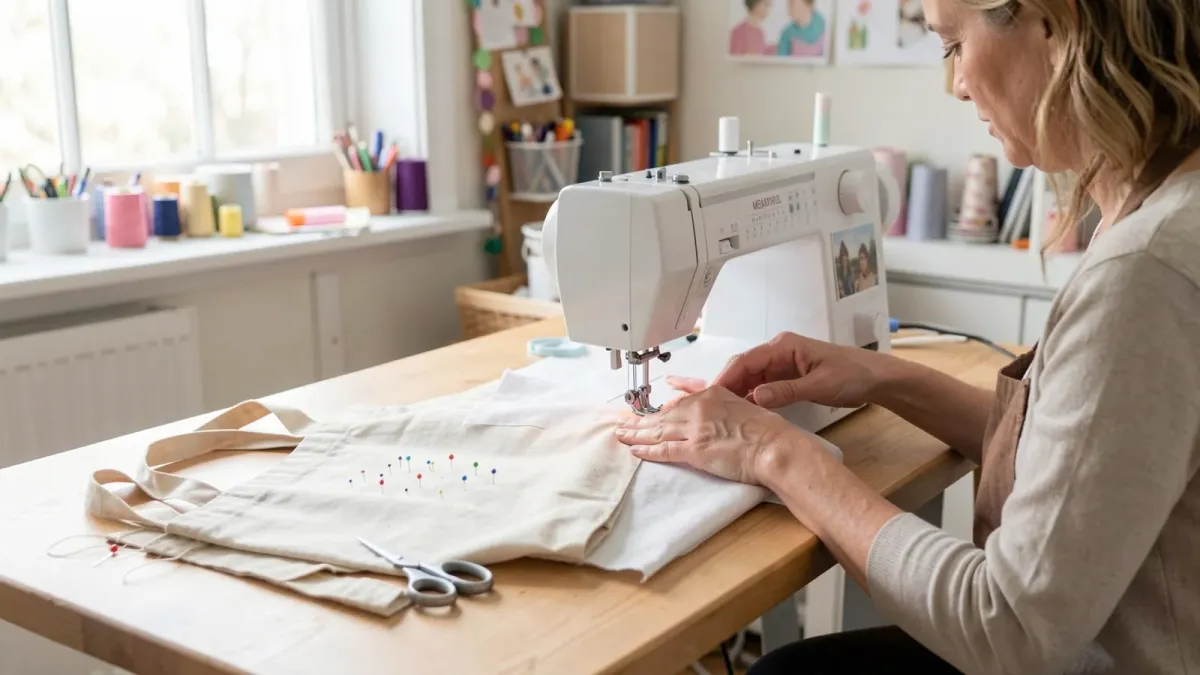
Usually pass, if the specific pattern is simple: napkins, an envelope cushion, a straight tote, a drawstring bag, a basic apron, an elastic-waist skirt in a woven cotton once you have sewn a bag or two. These are beginner-friendly sewing projects because the skills are visible and the mistakes are fixable with a seam ripper and a little extra fabric.
Can wait: jeans, tailored shirts, anything described as “a confidence-builder” that also includes a collar stand and a cuff, lingerie, very small children’s clothes with tight curves, and most “scrap-busting” projects made of twenty tiny pieces. Those can be satisfying later. They are a poor first buy.
A kit can be a kindness if the fabric is suitable and the instructions are complete. It can be a trap if the cloth is pretty and difficult, or if the kit is cheaper because the instructions are a single leaflet with no measurements. Open the list of contents in the description, and compare it with the table above, before you add it to a basket.
If you are choosing among free sewing projects for beginners, prefer a source that states the seam allowance, the fabric type, and the finished size, and that you have the right to use. A vague photo tutorial with no seam allowance is not a saving.
How to buy only one, and finish it
Pick a single project that you have a use for. Buy or print only that pattern, and only enough fabric for that size, after measuring. Schedule the preparation and the sewing as two sessions if you need to. Do not shop for the next beginner project until this one has been pressed and used, or at least honestly abandoned for a reason you can name.
If the pattern is a garment, compare your measurements with its chart, and look at the finished measurements. A “beginner dress” in a close size, on a body that sits between two charts, is no longer a beginner project unless you already like toile-making.
A checklist at the pattern shelf or the download button
- I can name the skills required, and I already have most of them, or only one new one
- The fabric on the list is stable and washable
- The closures are simple, or I am willing to swap in a simpler one
- The instructions look like instructions
- I have a use for the finished object
- I will not buy a second kit until this one is done
- If it is a PDF, I will print a test square at 100 percent
Questions people ask when everything is labelled “beginner”
What is the single best beginner sewing project?
The one you will finish. If you need a default, a square object — a napkin set or a cushion — is a safer first buy than a garment. The “best” label on a website is not a substitute for the table above.
Are kits better than patterns plus my own fabric?
They are better when the cloth is suitable and everything is included. They are worse when you cannot choose a friendlier fabric, or when you already have cloth at home that would do. Count the full cost, including whether you will actually like the fabric in a finished bag.
I have sewn a tote. Is a fitted dress the next step?
Usually not. A loose elastic-waist skirt, or a simple shirt with no collar, is a kinder step. Save the fitted dress until seams, pressing, and a size chart all feel ordinary.
What if I already bought a too-hard pattern?
You can put it aside without finishing it. That is cheaper than forcing it through, hating the machine, and buying a second difficult pattern to “prove” something. Make a small, complete object next, then come back if you still want to.