Sewing Starter Projects: Everything You Need to Know
Buy as little as will finish one useful thing
Sewing starter projects fail, in this house, when the first outing is a shopping outing. A starter machine, five metres of bargain fabric that pulls on the bias, a pattern with a zip, a welt, and a collar, and a pile of “just in case” feet will not teach you to sew. One small, finished object will. The economical start is a short list of projects, a short list of tools, and fabric you have washed before you cut.
Easy starter sewing projects share a few traits you can measure: mostly straight seams, a small number of pattern pieces, no fitted bodice on the first try, and a result you will actually use. A napkin, a simple tote, a cushion cover, a drawstring bag, or a straight apron will teach more than a complicated garment that never leaves the chair. Sewing machine starter projects should assume you can wind a bobbin, sew a straight line, and pivot a corner, and they should forgive a slightly wobbly allowance.
This is not a brand review, and it is not a promise that sewing will always cost less than buying. Some first projects save money. Some, honestly, are tuition you get to keep.
A first-projects table, with honest costs of time and fuss
| Project | What it teaches | Fabric and notions, kept lean | Leave it until later if |
|---|---|---|---|
| Napkins or a simple table runner | Straight seams, pressing, a square corner, a hem | Cotton you have washed; thread; maybe a modest interfacing-free hem | You have chosen a slippery or very thick cloth “because it was on sale” |
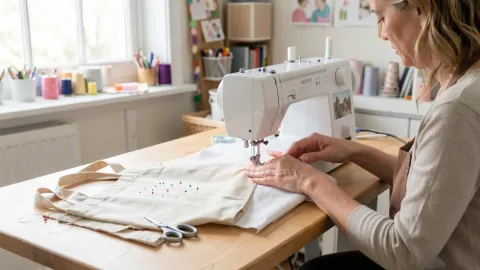
| A basic tote | Longer seams, a strap or a facing, a little reinforcement | A sturdy cotton or canvas, matching thread, a bag of patience for turning | The pattern also wants zips, linings, and boxed corners on day one — you can add those later |
| A cushion cover | Measuring a pad, leaving an opening, or a simple envelope back | The pad you already have, plus fabric cut to its actual measurements | A piped, zipped, tight designer cover as the first sew |
| A drawstring bag | A channel, a cord, a boxed or simple corner if you want one | A light cotton, a cord you can wash, a safety pin to thread it | A bag so small the channel becomes fiddly before you have the habit of a seam allowance |
| An apron with waist ties | Length, ties, a pocket if you insist on one | A mid-weight cotton, no odd stretch | A fitted, crossed-back style with invisible details |
| A simple skirt or a pair of loose trousers, much later | Waistbands, fitting, and the shock of body measurements | A pattern meant for beginners, in a mid-weight woven, after you have already finished a few soft-furnishing pieces | This is your first project, in a fabric that cost a lot and cannot be replaced |
If you already have a machine, start with what it can do without new feet. If you do not have a machine, a borrowed or second-hand one that already works is a better first spend than a new model with a dozen stitches you will not use this year. Test it on a scrap before you buy fabric to match it.
The small kit that actually gets used
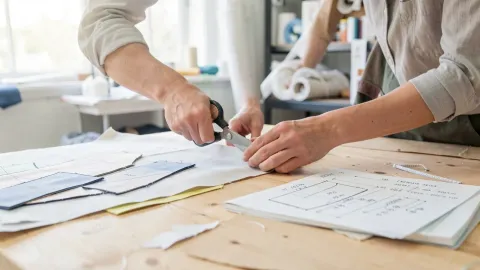
You need shears that cut cloth (and that do not cut paper after this day), a smaller pair for threads, pins or clips, a seam ripper you are willing to use, a tape measure, a seam gauge or a clear ruler, chalk or a removable marker, an iron and a board, and thread that matches well enough. A seam allowance that is consistent matters more than a decorative stitch.
You do not yet need a serger, a cutting table the length of the room, or a drawer of specialty feet. You may want a simple presser foot you already have, and a needle that suits the cloth — a universal needle for many cottons, and a change of needle when it starts making ugly holes or skipped stitches. Needles are cheaper than frustration.
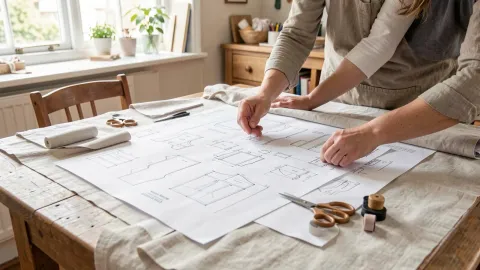
Measure twice: the object, the body if it is a garment, and the wash shrinkage. Pre-wash fabric the way you will wash the finished thing. A project that fitted on the table and shrank in the machine is a poor saving.
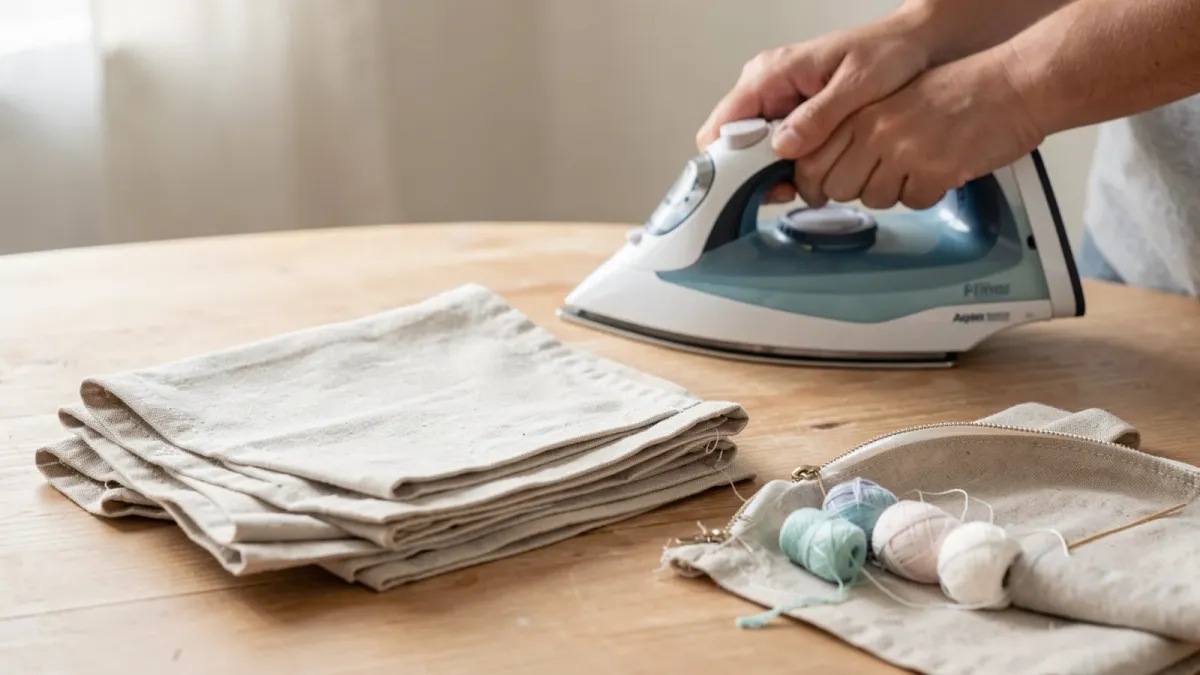
Work with the iron as you go. A seam that is pressed is easier to sew over than a seam you hope will flatten at the end. Unplug the iron when you stop. Keep shears and pins out of the path of anyone who might step or sit, and out of reach of children who should not be using them.
A sequence for the first month
- Get the machine sewing a straight, even line on a double scrap.
- Finish one tiny project, such as napkins or a bag for the same scraps.
- Finish one slightly larger useful object.
- Only then buy a beginner garment pattern, if you still want one, and make a cheap muslin or a wearable toile if the fabric is dear.
Count time as part of the cost. A “simple” tote can still be an evening plus a second evening for the straps. If you only have an hour, cut out, or sew one seam, or press, and stop. Unfinished work that is labelled and folded is not a failure.
A checklist before you cut the good fabric
- The first project has mostly straight seams and few pieces
- The fabric is washed and is not slippery or very thick
- I can name the seam allowance and I have a way to measure it
- The machine already sews a reliable straight line on a scrap
- The tool list is short, and the iron works
- I will finish this object before I buy the next pattern
- Needles, shears, and a hot iron have a safe place to live
Questions that come up once the receipt is already long
What is the best sewing starter project if I want to sew clothes eventually?
Still a straight-seamed household object, then a loose, simple garment in a cheap woven cloth. Jumping straight to a fitted dress teaches fear and an expensive unpicking habit. The skills transfer. The money does not, if the dress fails.
Do I need an expensive machine for starter projects?
No. You need a machine that feeds evenly, makes a lockstitch you can live with, and has a working tension and bobbin. Fancy stitches will not rescue an uneven seam allowance.
How much fabric should I buy at the start?
Enough for the project, after pre-washing, plus a little extra for mistakes if the cloth is inexpensive. A large “stash” bought before you know what you enjoy is how odd lengths accumulate. Measure the project, then buy.
Can children share these starter projects?
They can share some of the work, with close supervision, blunt education scissors if they are cutting, and no access to the iron or to a running machine without you. A first project should still be yours to finish if they wander off. This is not a substitute for a class designed for their age.