Sewing Patterns UK: Everything You Need to Know
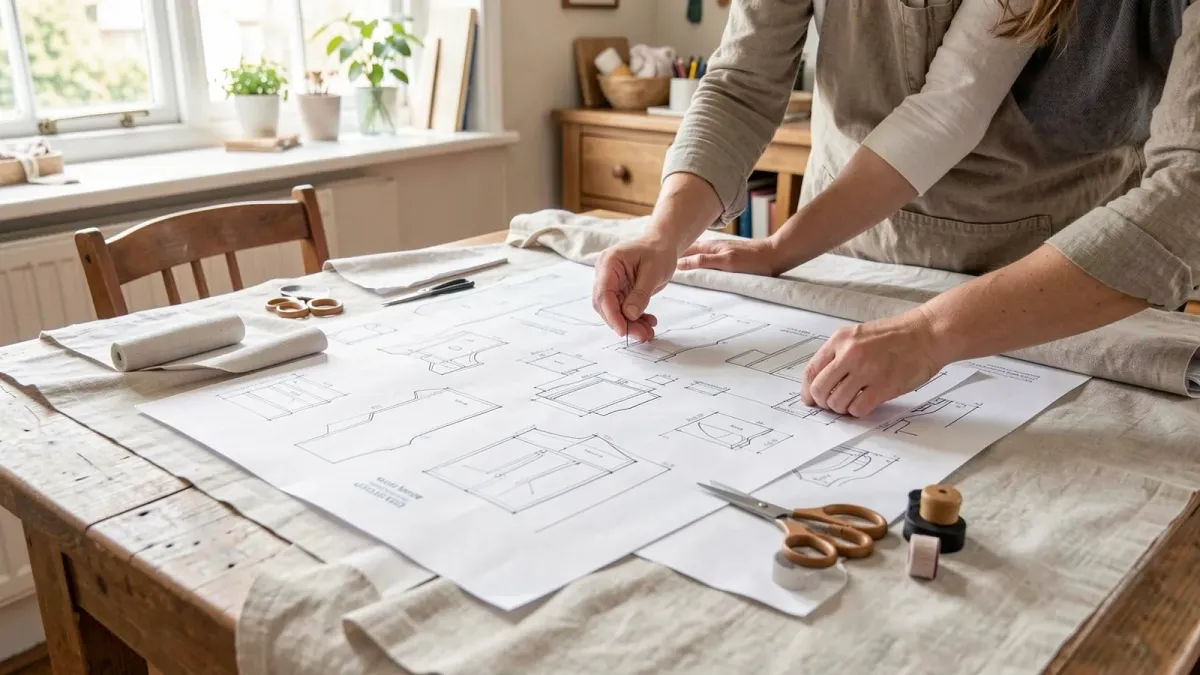
Measure the body, then read this pattern’s chart, not a high-street size
Sewing patterns in the UK are sold in paper, as PDFs, and as kits, by high-street pattern companies and by independent designers. They all have one habit in common that still catches people: the number on the packet is not automatically the number on a ready-to-wear label. A pattern “UK 12,” or a designer’s size 3, is only a key to that company’s chart. Your tape measure, in centimetres, is the real starting point.
Take a bust, waist, and hip measurement the way the pattern asks, standing in ordinary underclothes, with the tape level and snug but not tight. Write the figures down. Then open the pattern’s own size chart, in the same units, and find the closest match. If you sit between sizes, many people grade between them, or choose by the fitted area of that garment — the bust on a close bodice, the hip on a loose dress. Guessing from a shop size is how a neatly sewn garment still does not fit.
This is a buying and measuring guide, not a review of named brands, which we will mention only as examples in plain text when useful, and not as links. Ease, fabric stretch, and the designer’s intended look will change the result as much as the number in the circle.
Paper, PDF, and the test square
A paper sewing pattern from a UK shop or a trade counter is ready to cut or to trace. Tracing is often the cheaper long-term habit if you might need two sizes, or if you want to keep the original intact. Use a paper you can see through well enough, and transfer notches faithfully.
A PDF pattern is a file you print, usually at home or at a copy shop, then assemble. The economy depends on your printer and your patience. The non-negotiable step is the test square, or test box, printed at 100 percent scale, with no “fit to page.” Measure that square with a ruler. If it is not the size the file says it should be, do not assemble twenty pages and hope. Adjust the print settings and try again. A pattern that is 2 percent small is a pattern that will not match its own chart.
Check whether you need all the layers or only one size, if the file offers layered printing. Printing every size on every page, in a language of overlapping lines, is a poor use of ink and of eyesight. Check, also, whether the file is formatted for A4, for A0 copy-shop sheets, or for both. A0 at a copy shop can be cheaper in time, if not always in money, than taping thirty A4 pages on the floor.
| Question | What to do in practice | Why it saves money |
|---|---|---|
| Which size am I? | Use this pattern’s chart and your current measurements | You avoid cutting a size that only matches a high-street label |
| Paper or PDF? | Paper if you want to unroll and start; PDF if you want a specific independent design and will print carefully | You do not pay twice, once for a file and once for a failed, mis-scaled print |
| Trace or cut the original? | Trace if you may need another size, or if the pattern was dear | A second size then costs paper, not a second pattern |
| How much ease is in this design? | Read the finished garment measurements, not only the body chart | A “12” with a lot of ease and a “12” with little ease are different clothes |
| Which fabric will the pattern accept? | Believe the list: woven versus stretch is not a suggestion | The wrong fabric makes even a well-sized pattern feel like the wrong size |
| Do I need the whole envelope? | Check the views. Buy or print only the view you will sew, if the pattern allows | Extra views are tuition you can collect later |
| What about multi-size sheets? | Highlight your size before you cut, and check the cutting layout for that size | It is easy to follow the wrong line on a crowded sheet |
If you are between two pattern companies, do not carry a size from one chart onto the other. Measure again, read again.
Ease, fabric, and UK shopping habits
Finished measurements, when they are printed, are often more useful than the size number. They tell you how much room the designer left. A shirt with a lot of ease can be cut from a smaller pattern size than a close dress, even on the same body. If finished measurements are missing, that is a reason to look for a review from a sewer who measured theirs, or to make a cheap toile.
Fabric widths in UK shops are often 112 or 140 centimetres, or similar, but you must still read the pattern’s requirement for your size and width. Buy enough for shrinking if you will pre-wash, which you generally should, and enough for a nap or a directional print if you have one. A “bargain” length that is 20 centimetres short is not a bargain.
Independent UK designers and larger commercial pattern lines can both be beginner-friendly, or not. Judge the instruction booklet, the number of pattern pieces, and the skills listed, not the nationality of the company. If a pattern assumes you already know a zip fly, it is not a first zip project just because it is sold in a UK shop.
Keep receipts and the envelope or the file name. If a measurement typo or a missing piece has to be checked, you will need to know exactly what you bought. Most reputable companies publish corrections. Check those before you cut, especially if the pattern has been around for a while.
A checklist for a UK pattern purchase
- I have current bust, waist, and hip measurements, in centimetres
- I have compared them with this pattern’s chart, not with a shop size
- I have looked at finished measurements and the fabric type
- A PDF, if that is what I am buying, will be printed at 100 percent and checked against the test square
- I have enough fabric for my size, width, and shrinkage
- I will trace if I need to keep more than one size
- I will not start cutting until the instructions have been read once through
Questions UK sewers ask at the counter and on the download page
Why don’t I fit the size I wear in shops?
Because the charts are different, and because ready-to-wear uses its own ease, vanity sizing, and block. It is not a defect in your body or automatically a defect in the pattern. Measure, then choose.
Are UK and US pattern sizes the same?
Not reliably. Some companies use their own numbering entirely. Always use the chart in the pattern you have in your hands, and the same unit of measurement throughout. Do not convert a remembered “size 12” across the Atlantic from memory.
Is a PDF cheaper than a paper pattern?
Sometimes the file is cheaper, until you add paper, ink, tape, and time, or an A0 print fee. Sometimes it is still cheaper, and it is easier to reprint a ruined page. Do the little sum, including the test-square step, before you decide that the file is a saving.
Can I share a PDF with a friend?
Usually no, unless the licence says so. A PDF is still a copyrighted pattern. Buy a second copy, or choose a pattern that explicitly allows a certain kind of sharing, rather than treating a file as communal fabric.